
Faster Reviews
Structured findings in under 45 minutes, instead of days of manual review.
Generic AI can read ASPICE documents, but AutoAssesspro.AI evaluates assessment readiness. Using ASPICE-specific expertise, AI analysis, and toolchain integration, it reviews work products, identifies gaps early, and helps teams maintain continuous assessment readiness.
Built for Automotive Engineering Organizations Worldwide
 Purpose-built for
ASPICELLM-AgnosticEnterprise-Ready
Developed with
BorgWarner
Purpose-built for
ASPICELLM-AgnosticEnterprise-Ready
Developed with
BorgWarnerEngineering teams spend weeks manually reviewing work products, chasing evidence, and fixing issues discovered just before an assessment.
AutoAssesspro.AI shifts assessment readiness from a reactive activity to a continuous engineering practice — helping teams identify gaps early, improve consistency, and reduce last-minute effort.
AutoAssesspro.AI is purpose-built ASPICE assessment software and ASPICE review software — engineered from the ground up as AI for ASPICE and Automotive SPICE AI, not general-purpose automation retrofitted for engineering work product review.
Generic Agentic AI platforms are excellent for broad automation, document summarization, and workflow orchestration. But ASPICE assessment readiness requires more: domain-specific knowledge, deterministic review logic, and deep engineering context.
AutoAssesspro.AI is built around exactly that gap, combining ASPICE domain expertise, deterministic review logic, AI-powered analysis, and Omnex's O-BOT architecture into one enterprise-ready platform, contextualized to your organization's data for higher contextual accuracy from day one.
Import work products from tools such as Jira, Polarion, SharePoint, or document repositories.
AI and deterministic logic review requirements, architecture, traceability, test cases, and evidence.

Receive structured findings aligned with ASPICE expectations.
Resolve issues before formal assessment.
Continuously monitor assessment readiness across projects.
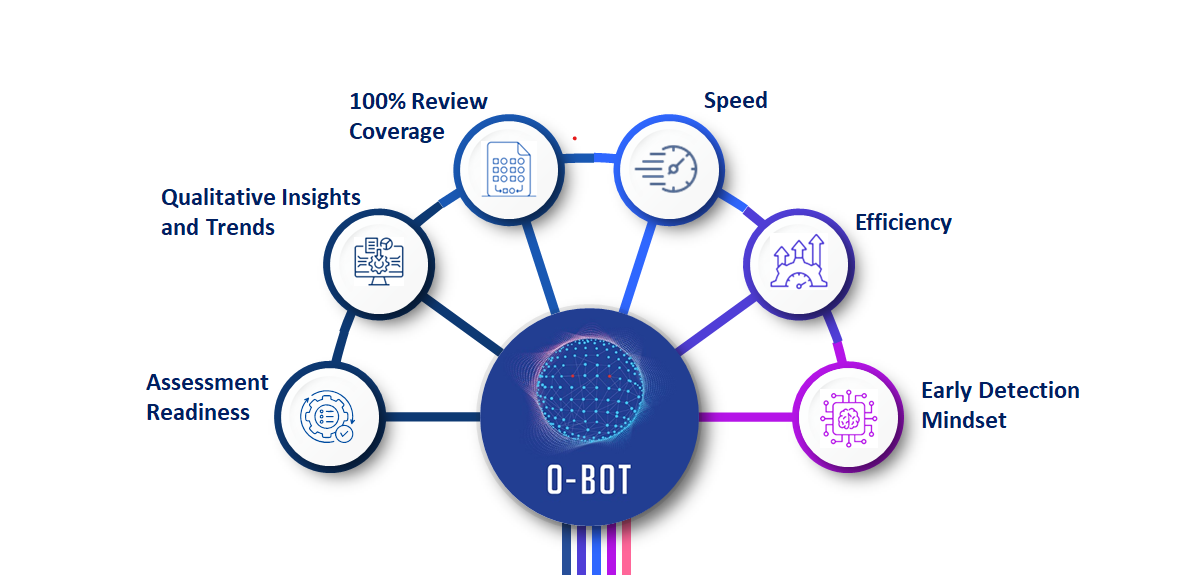
Value Extraction — how AutoAssesspro.AI's O-BOT delivers 100% review coverage, speed, efficiency, early detection, assessment readiness, and qualitative insight.

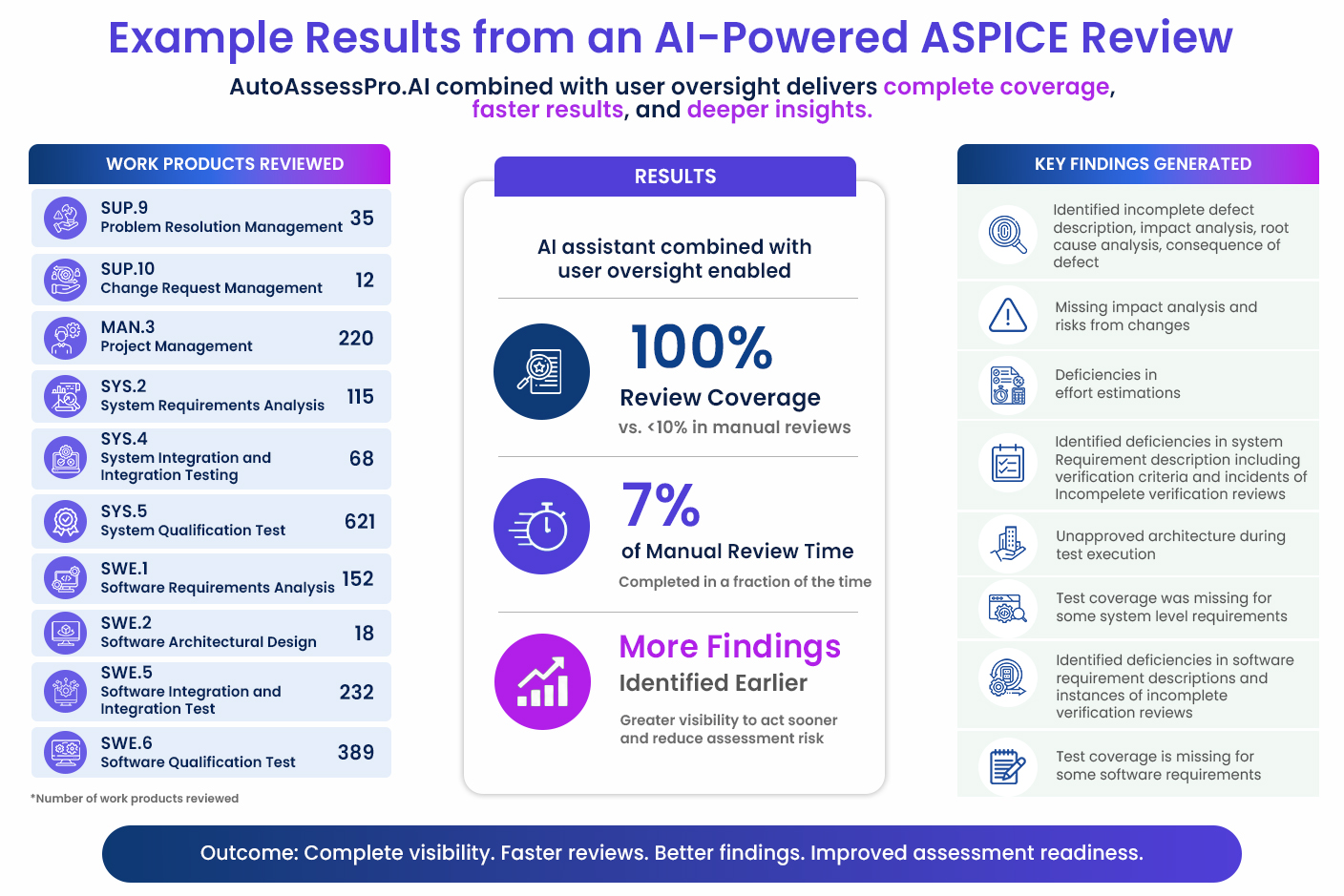
Structured findings in under 45 minutes, instead of days of manual review.

Reviews every relevant work product (100% sampling) instead of manually sampling fewer than 10%.

Reduces manual review effort from days to hours, without building an internal AI product team.

Moves from pilot to production without months of custom domain modelling, prompt engineering, and validation.

Up to $900K–$1.4M in savings per project, plus $150K–$170K in organizational overhead savings.

Embeds ASPICE domain logic into the product, reducing reliance on scarce ASPICE experts to define and validate reviews.

AutoAssesspro.AI was developed in partnership with BorgWarner, one of the automotive industry's leading Tier 1 suppliers, and is built on Omnex's ASPICE assessment and automotive quality expertise.
AutoAssesspro.AI's advantage goes deeper than a single feature. Here's the detailed comparison across three areas: technical capability, technology architecture, and total cost of ownership.
| Area | Generic Agentic AI Software | AutoAssesspro.AI Advantage |
|---|---|---|
| Purpose | General AI automation platform requiring custom use-case development | Built specifically for ASPICE work product review, assessment readiness, and process improvement |
| ASPICE Knowledge | Does not inherently understand ASPICE PAM, base practices, work products, outcomes, and assessment expectations | Preconfigured with ASPICE process knowledge, assessment logic, and work product expectations |
| Engineering Context | Requires significant configuration to understand embedded systems, software development, requirements, design, testing, verification, validation, and traceability | Designed for automotive engineering, embedded systems, software development, and ASPICE evidence review |
| Evidence Review | Can summarize or extract information, but may not reliably determine whether evidence is sufficient for ASPICE | Reviews work products against expected ASPICE evidence, identifies gaps, and supports assessment readiness |
| Traceability Review | Needs custom logic to evaluate requirement-to-design-to-test traceability | Built to evaluate engineering traceability across requirements, architecture, verification, validation, and project evidence |
| Assessment Consistency | Output can vary based on prompt, agent design, and user interpretation | Provides structured and repeatable review logic aligned with ASPICE expectations |
| Expert Dependency | Requires ASPICE experts to define rules, validate prompts, interpret outputs, and maintain review logic | Reduces dependency on scarce ASPICE experts by embedding domain logic into the product |
| Preventive Review | Usually used as an assistant after configuration | Can be used proactively during project execution to identify gaps before formal assessment |
| Scalability Across Projects | Each new project or business unit may require additional configuration | Designed to scale across projects, programs, and business units with reusable review structures |
| Assessment Readiness | Requires significant manual effort to consolidate, correlate, and analyze assessment data, as there is no standardized ASPICE-specific evaluation logic consistently applied across projects | Generates findings and improvement actions to support assessment preparation. |
| Efficiency Gains | Requires extensive effort to review, validate, and consolidate findings, as ASPICE compliance logic is not inherently embedded | Reduces review effort from days to hours or even minutes by leveraging predefined and standardized ASPICE assessment logic consistently applied across all projects |
| Area | Generic Agentic AI Software | AutoAssesspro.AI Advantage |
|---|---|---|
| AI Model Approach | Often heavily dependent on a specific LLM or agent framework | Built on Omnex's O-BOT framework, designed to be LLM-agnostic |
| LLM Flexibility | May lock the customer into one LLM provider or architecture | Supports an architecture that can work across different LLMs based on customer, security, cost, and deployment needs |
| Deterministic Review Logic | Many generic tools are primarily probabilistic, making output consistency a challenge | Combines AI with deterministic rules, structured review logic, and evidence-based validation |
| Hallucination Risk | Higher risk if not properly governed, especially in technical compliance use cases | Lower risk because outputs are grounded in defined ASPICE expectations, evidence mapping, and configured review logic |
| Connector Framework | Connectors often need to be custom-built or purchased separately | Provides a connector framework to integrate with the engineering toolchain |
| Toolchain Integration | Requires additional development to connect to Jira, Polarion, SharePoint, MS Project, document repositories, ERP, and ALM/PLM systems | Designed to connect to common engineering repositories and work product sources |
| Data Ingestion | May require manual upload or custom pipelines | Supports structured ingestion of work products from documents, repositories, and connected systems |
| Reusable Framework | Use-case logic often has to be rebuilt for each domain | O-BOT framework supports reusable domain bots and future expansion into ASPICE, FuSa, Cybersecurity, and other engineering areas |
| Governance | Needs separate configuration for access control, review logic, validation, and traceability | Designed with enterprise deployment, review workflows, and governance in mind |
| Configurability | Highly flexible but requires technical AI resources to configure | Configurable for customer needs while preserving a domain-specific foundation |
| Area | Generic Agentic AI Software | AutoAssesspro.AI Advantage |
|---|---|---|
| Initial Development Cost & Time to Deploy | High cost and longer deployment cycle. Customer must fund use-case discovery, ASPICE logic development, prompt engineering, workflow design, integrations, testing, and validation before go-live. | Lower implementation cost and faster time to value because ASPICE review logic, architecture, and workflows are already productized. |
| AI & ASPICE Expert Dependency | Requires AI architects, prompt engineers, data engineers, integration developers, and governance specialists, plus significant involvement from scarce and expensive ASPICE experts to define and validate the model. | Reduces the need to build a full AI product team; Omnex embeds ASPICE expertise into the product and supports configuration, deployment, and continuous improvement. |
| Maintenance Cost | Customer must maintain prompts, agents, workflows, connectors, models, and compliance logic. | Omnex maintains the product platform, domain logic, connector framework, and roadmap enhancements. |
| Model Management Cost | Customer must manage LLM selection, performance, cost, security, model drift, and updates. | O-BOT framework is designed to be LLM-agnostic, reducing model lock-in and allowing optimization over time. |
| Integration Cost | Each toolchain integration may require separate development effort. | Connector framework reduces the cost and complexity of connecting to engineering systems. |
| Validation Cost | High cost to validate whether the generic AI output is acceptable for ASPICE use. | Built with structured review logic to support more consistent and evidence-based output. |
| Total Cost of Ownership | Higher long-term TCO due to custom development, scarce resources, maintenance, validation, and ongoing AI governance. | Lower TCO because domain capability, AI framework, connectors, product support, and roadmap are shared through a productized platform. |
| Scalability Cost | Cost increases significantly as more projects, sites, tools, and process areas are added. | Designed to scale across programs, projects, and business units with reusable configuration and deployment patterns. |
| Business Risk | Higher risk of building a custom solution that may not be reliable, validated, scalable, or accepted by assessors. | Lower risk because the product is focused on ASPICE review, engineering evidence, and assessment readiness. |

Faster ASPICE reviews

Consistent, repeatable findings

Reduced dependency on scarce ASPICE experts

Lower implementation risk

Enterprise-grade scalability

LLM flexibility, no vendor lock-in

Purpose-built for Automotive SPICE
Schedule a live demo and see AutoAssesspro.AI review real ASPICE work products with deterministic accuracy, not just a generic AI's best guess.
Request Demo
Standardize with domain expertise. Deploy with confidence. Scale without the guesswork.